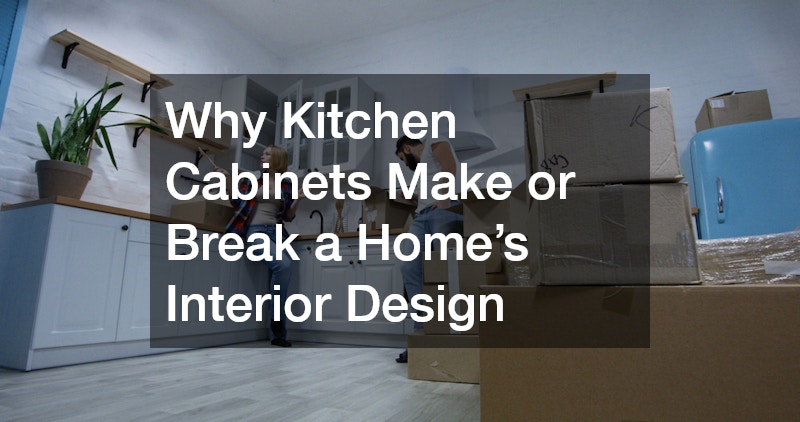
When we think about interior design, our minds often wander to the glamorous elements: the plush velvet sofa in the living room, the statement chandelier over the dining table, or the perfectly curated gallery wall. But if you want to know the true litmus test of a home’s design success, you have to look at the kitchen. Specifically, you have to look at the cabinets.
Kitchen cabinets are not just boxes with doors meant to hide your mismatched coffee mugs and Tupperware. In modern interior design, they are the literal and figurative anchor of the home.
Because the kitchen has evolved from an isolated cooking zone into the social hub of the household, your cabinetry choices carry immense architectural and aesthetic weight.
Here is a deep dive into why kitchen cabinets will absolutely make or break your home’s interior design.
They Dictate the Visual Real Estate
Think about that for a second. When you walk into an open-concept living area, your eyes don’t immediately register the countertops or the backsplash; they register the massive vertical expanse of wood, paint, or laminate that makes up your cabinets.
Because they dominate the visual field, your cabinets set the tone for the entire floor plan. If you choose a sleek, handle-less minimalist flat-panel design, the rest of your home is instantly pulled toward a contemporary vibe. If you choose a heavy, dark-stained traditional raised-panel door, the home leans classic and formal. You cannot fight what your cabinets are saying—they speak too loudly.
The Great Open-Concept Unifier
The days of the kitchen being tucked behind a closed door are long gone. Today’s homes champion open-concept living, where the kitchen, dining, and living rooms flow seamlessly into one another.
This architectural shift changed the rules of interior design. Now, your kitchen cabinets are on full display while you are sitting on your living room sofa.
The Design Danger: If your kitchen cabinetry doesn’t converse with the rest of your main floor’s design language, the entire house feels disjointed.
Well-designed cabinets act as a bridge. For instance, matching the wood species of your kitchen island cabinetry to the floating shelves or media console in the living room creates a cohesive, intentional flow. When the cabinets fail to connect to the rest of the space, the kitchen looks like a random showroom dropped into the middle of a house.
They Define the Line Between Symmetry and Chaos
Great interior design relies heavily on visual balance, scale, and proportion. Because cabinets are large structural elements, how they are arranged dictates the geometry of the room.
-
Symmetrical Layouts: Create a sense of calm, formality, and timeless luxury (think matching pantry towers flanking a central range).
-
Asymmetrical Layouts: Offer a dynamic, modern, and casual feel (think a wall of lower cabinets paired with open shelving on one side).
If the cabinet design is poorly thought out—such as jagged upper heights, awkward gaps near the ceiling, or doors of drastically varying widths—it creates visual noise. No amount of beautiful marble countertops or high-end appliances can rescue a kitchen from the chaotic energy of badly proportioned cabinets.
Hardware: The “Jewelry” of the Home
If cabinets are the outfit, the hardware is the jewelry. The knobs, pulls, and latches you choose have a disproportionate impact on the overall vibe of the room.
This is where interior designers love to play, because changing the hardware can completely shift the design narrative. Sleek matte black pulls can modernize a classic Shaker door, while unlacquered brass latches can infuse a brand-new kitchen with old-world charm.
When cabinetry hardware is cheap, poorly spaced, or mismatched, it cheapens the entire room. Conversely, high-quality, tactile hardware elevates the sensory experience of interacting with your home every single day.
Investing in your kitchen cabinets is not just a renovation expense; it is a foundational design decision. They hold the power to elevate a modest home into a sophisticated sanctuary or make a luxury home feel cheap and poorly planned.
When planning your next home upgrade, don’t treat your cabinetry as an afterthought or a mere storage utility. Treat it as the canvas upon which the rest of your home’s style is painted. Get the cabinets right, and the rest of your interior design will naturally fall into place.